From the death of a woman in Minnesota to federal immigration raids in North Carolina, resistance is an awful reminder of a society once governed by slavery.
By Martin Henson
Beacon Media
I can imagine the scene: Locked shoulder to shoulder, frightened passengers sweat, as the ziptied, kidnapped victims of immigration enforcement.
The idea this could be me feels more real than it should as the federal immigration raids have hit close to home in recent weeks. Durham’s Avondale Drive, Raleigh’s Capital Boulevard and Charlotte’s Central Avenue were central sites of these roundups, streets that have now betrayed the safety of all who live there.
A quiet voice inside me reminds me that I am a “legal” citizen, with natural born citizenship, and I shouldn’t need to care— but chattel slavery was legal once. I fear that the time when the North Carolina General Assembly did not allow Black people to walk without a pass will come again.
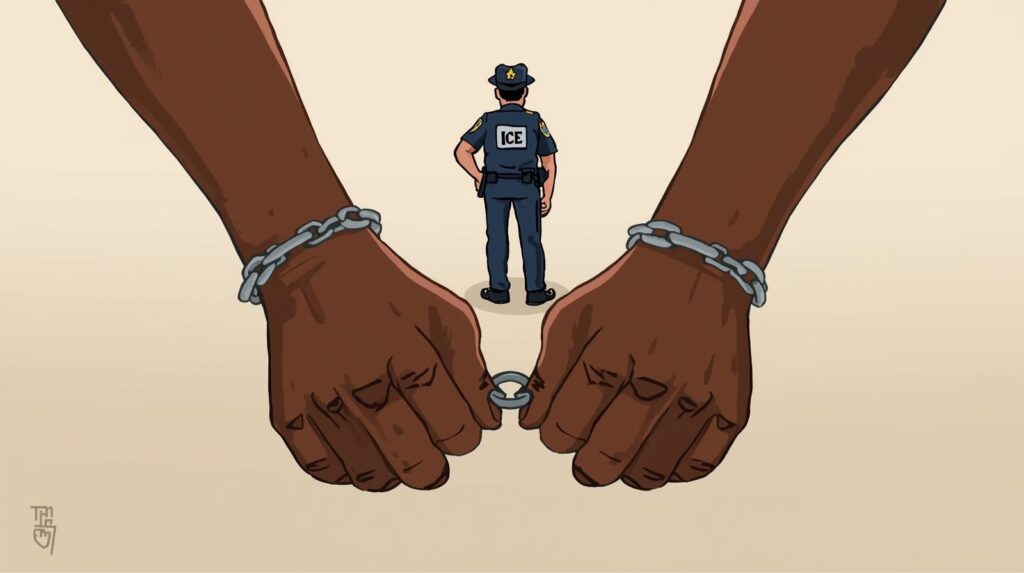
The U.S. Immigration and Customs Enforcement (ICE) and other federal law enforcement evoke a shared racial terror in both Black and Latino communities, the type that reforms the state power responsible for slavery into immigration enforcement.
Back when white men were deputized to catch slaves, Black people lived in fear of being removed from their loved ones. The marauding bands of ICE agents exist to soothe a similar temperament, due to what sociologists call the “browning” of American society, which is becoming more diverse and has led to a lot of fear among many white people. I feel a connection between Black and Latino, two communities under siege by a system that loves our labor but hates our presence.
Last week, point-blank gunshots fired from an ICE agent to an unarmed mother and poet named Renee Nicole Good in Minnesota. Good’s death mirrors that of Heather Heyer, both dying in defense of communities of color.
All this as the Trump administration’s stated reason for these actions— that violent undocumented immigrants are ruining America — is based on fear and racism, not reality. 65 percent of people detained as of June had no criminal record, and around 90 percent had no convictions for a violent crime. Overall, undocumented immigrants have much lower crime rates than native-born Americans.
The search for “those who do not belong” is littered the collateral damage of those who dare to protest, record, observe or are simply in the wrong place at the wrong time.. Some never come home.
I half-joked to a friend recently that Donald Trump might deport anyone, regardless of immigration status. I shifted in my seat, uncomfortable with the idea that I might become “Illegal,” pushing an uneasy comparison to slavery from my subconscious into conscious thought.
My thoughts muddle through this. I am safe, right? I am supposed to feel safe in my own home and my own country — right? As a Black man and a person who opposes the current regime, I don’t feel safe. Hearing about families in hiding creates a fearful sort of disgust in me. Even though I’ve never been a slave, the handcuffs I see on the detained victims of immigration enforcement seem more like the chains that survived the end of chattel slavery than the results of a border patrol sweep. The past lives in me. I feel like a spectator in the immigration fight, yet over 150 years ago, Black people in Durham were once in the same position as the Latino community, fearing their loved ones being ripped from them.
About 6 miles away from the Avondale Drive ICE sits the Stagville plantation, where in 1844, Paul Cameron forced 114 enslaved people to walk “the trek,” 500 miles from Durham to their new plantation in Alabama. Uprooted from their homes, split from their family, going to unknown destinations.
Prevailing ideas of human value refuse the distinction marking a slave’s journey from an immigrant’s search for new opportunities. Denial of land, employment, and safety makes kindred spirits of dissimilar causes. The dehumanizing justifications for exploitation, the replaceability of “cheap labor” and the promise of freedom bind different modes of resistance together.
This logic appears again today.
It is an impossible choice the oppressed must navigate: enslaved people chose between flee or die; immigrants choose to hide or leave.
This convergence on the land that I have come to know brings fear, but it also brings hope. Chattel slavery ended because my ancestors made it untenable. On this land, we have seen the horrors of stripping people away from their families. It is more than my body telling me that I should resist: it is the history of the land, and my ancestors telling me that an immigrant and my forefathers are caught in the same fate, and we should fight for the justice everyone deserves.
Martin Henson, who lives in Raleigh, is an advocate and executive director of BMEN Foundation, which convenes Black men to address issues in their lives and communities. See his work at MartinHSpeaks.com. This column is syndicated by Beacon Media and is available to republish for free on all platforms under Beacon Media’s guidelines.
Martin Henson: La resistencia ante ICE no es solo una cuestión de inmigración
Desde la muerte de una mujer en Minnesota hasta las redadas federales de inmigración en Carolina del Norte, la resistencia es un terrible recordatorio de una sociedad que una vez estuvo gobernada por la esclavitud.
Por Martin Henson
Beacon Media
Puedo imaginarme la escena: pasajeros encerrados, amontonados, sudando, como víctimas de secuestro, atados con cintas plásticas en manos de las autoridades de inmigración.
La idea de que esto podría pasarme a mí me parece más real de lo que debería, ya que las redadas federales de inmigración siguen afectando cerca de casa en las últimas semanas.
Avondale Drive en Durham, Capital Boulevard en Raleigh y Central Avenue en Charlotte fueron los lugares centrales de estas redadas hacia finales de 2025; ahora están marcadas como calles que han traicionado la seguridad de todos los que viven allí. Una voz tranquila dentro de mí me recuerda que soy un ciudadano “legal”, con ciudadanía por nacimiento, y que no debería tener que preocuparme – pero la esclavitud también fue legal en algún momento.
Temo que vuelva a llegar el momento en que la Asamblea General de Carolina del Norte no permita a las personas negras caminar sin un permiso como fue en un pasado. El Servicio de Inmigración y Control de Aduanas de Estados Unidos (ICE) y otras fuerzas del orden federales evocan un terror racial compartido tanto en las comunidades negras como en las latinas, del tipo que nos recuerda que es posible transformar el mismo poder estatal responsable de la esclavitud en la aplicación de las leyes de inmigración.
En la época en que se asignaba a los hombres blancos a capturar esclavos, la gente negra vivía con el temor de ser separada de sus seres queridos. Las bandas de agentes de ICE que merodean existen para calmar un temperamento similar, debido a lo que los sociólogos llaman “the browning” (el crecimiento de las personas de color) de la sociedad estadounidense, que se está volviendo más diversa y ha provocado mucho miedo entre mucha gente blanca. Siento una conexión entre las personas negras y latinas, dos comunidades asediadas por un sistema que ama nuestro trabajo pero odia nuestra presencia.
La semana pasada, los disparos de un agente de ICE le quitaron la vida a una madre y poeta desarmada llamada Renee Nicole Good en Minnesota. La muerte de Good refleja la de Heather Heyer en Charlottesville, Virginia, ya que ambas murieron defendiendo a las comunidades de color.
Todo esto está sucediendo y mientras tanto, la razón que ha dado la administración Trump para estas medidas —que violentos inmigrantes indocumentados están arruinando los Estados Unidos— se basa en el miedo, el racismo y no en la realidad. La verdad es que el 65% de las personas detenidas hasta junio no tenían antecedentes penales y alrededor del 90% no tenían condenas por delitos violentos. En general los estudios muestran que los inmigrantes indocumentados tienen índices de criminalidad mucho más bajos que los estadounidenses nativos.
La búsqueda de “los que no pertenecen” está llena de daños colaterales dirigidos a quienes se atreven a protestar, grabar, observar o simplemente se encuentran en el lugar equivocado en el momento equivocado. Algunos nunca regresan a casa.
La búsqueda de “los que no pertenecen” está llena de daños colaterales causados a quienes se atreven a protestar, grabar, observar o simplemente se encuentran en el lugar equivocado en el momento equivocado. Algunos nunca regresan a casa.
Mis pensamientos se confunden con esto. ¿Estoy a salvo, verdad? Se supone que debo sentirme seguro en mi propia casa y en mi propio país, ¿no? Como hombre negro y persona que se opone al régimen actual, no me siento seguro.
Oír hablar de familias que viven escondidas me produce una especie de asco mezclado con miedo. Aunque nunca he sido esclavo, las esposas que veo en las víctimas detenidas por las autoridades de inmigración se parecen más las cadenas que sobrevivieron al fin de la esclavitud que el resultado de una redada de la patrulla fronteriza. El pasado vive en mí.
A unas seis millas de Avondale Drive en Durham, Carolina del Norte, se encuentra la plantación Stagville, donde en 1844 Paul Cameron obligó a 114 esclavos a recorrer a pie “the trek” (la travesía) de 500 millas desde Durham hasta la nueva plantación de su familia en Alabama. Desarraigados de sus hogares, separados de sus familias, los esclavos caminaron hacia un destino desconocido.
A unas seis millas de Avondale Drive en Durham, Carolina del Norte, se encuentra la plantación Stagville, donde en 1844 Paul Cameron obligó a 114 esclavos a recorrer a pie “the trek” (la travesía) de 500 millas desde Durham hasta la nueva plantación de su familia en Alabama. Desarraigados de sus hogares, separados de sus familias, los esclavos caminaron hacia un destino desconocido.
Me siento como un espectador en la lucha migratoria, pero hace más de 150 años, la comunidad negra de Durham se encontraba en la misma situación que la comunidad latina, temiendo que les arrebataran a sus seres queridos.
Las ideas predominantes sobre el valor humano rechazan la distinción que marca la travesía de un esclavo a la búsqueda de nuevas oportunidades de un inmigrante. La denegación de tierras, empleo y seguridad crea afinidades entre causas diferentes. Las justificaciones deshumanizantes para la explotación, la reemplazabilidad de la “mano de obra barata” y la promesa de la libertad unen diferentes formas de resistencia.
Esta lógica vuelve a aparecer hoy en día.
Es una elección imposible que los oprimidos deben afrontar: los esclavos eligieron entre huir, sufrir o morir; los inmigrantes eligen entre esconderse o irse.
Esta convergencia en la tierra que he llegado a conocer me da miedo, pero también me da esperanza. La esclavitud terminó porque mis antepasados la hicieron insostenible. En esta tierra hemos visto los horrores de arrancar a las personas de sus familias. Es más que mi cuerpo el que me dice que debo resistir: es la historia de la tierra y mis ancestros los que me dicen que un inmigrante y mis progenitores están atrapados en el mismo destino, y que debemos luchar por la justicia que todos merecemos.
Martin Henson, quien vive en Raleigh, es un defensor y el director ejecutivo de la Fundación BMEN que reúne a hombres negros para abordar cuestiones relacionadas con sus vidas y sus comunidades. Puedes ver su trabajo en MartinHSpeaks.com. Esta columna está distribuida por Beacon Media y se puede volver a publicar de forma gratuita en todas las plataformas siguiendo las directrices de Beacon Media.