
Being a liberal in a rural area can be lonely. The author writes that progressives can lower the political temperature and restore trust in their beliefs through community projects.
By Anthony Flaccavento
Rural Urban Bridge Initiative
In the summer of 2023 in Virginia’s Shenandoah Valley, eight volunteers from the county Democratic Party joined local church members to restore a home for an elderly woman and her five grandchildren. Their home had been damaged by fire, leaving them to live in their garage for months. It took days to repair, paint, clean and make the home habitable again.
This was the first of what now totals nearly one hundred projects undertaken by the Page County, Va., chapter of Community Works since 2022. I and my colleagues at the Rural Urban Bridge Initiative (RUBI) formed Community Works in Page and other rural counties to test a simple proposition: What would happen if liberals and Democrats in rural, “red” areas started working to fix local problems, side by side with their more conservative neighbors? We wanted to see if animosity and mistrust would decline. We hoped that putting “love thy neighbor” into practice might be the first step in reversing extreme political polarization.
Those of us leading RUBI believed restoring trust was a prerequisite to restoring our democracy and rebuilding our nation.
Across the country, more and more people are embracing this idea of community service as a means to fix local problems and overcome partisan mistrust. Some of that energy is emerging from rural Democratic Party chapters in states as different as Minnesota and Wyoming. Others, like Brickyard, are completely non-partisan. In that case, local veterans are key leaders of community service work.
A Ford Foundation assessment found that “when people come together around a concrete, local problem and a commitment to their shared future, the labels and divisions that dominate national politics tend to fade into the background.”
This is exactly what Meredith Dean, National Director of Community Works, has found. “We’ve seen how working side by side with neighbors, whether picking up trash, packing food boxes for seniors, installing smoke alarms or doing home repairs begins to change views, in both directions,” Dean told me. “National politics, and the media surrounding it, intensifies partisanship and mistrust of everyone on the ‘other team,’ whereas Community Works refocuses hearts and minds on what’s possible when we work together.”
Liberals in rural areas know first-hand how bad our reputation is with the great majority of our neighbors. Mistrust of liberal culture and the Democratic Party is widespread and intense. Our “brand” stinks.
As a result, progressives and liberals often keep to themselves except when joining public protests led by like-minded folks. I get this. I’ve been part of many such gatherings myself. But reaching out to our conservative neighbors is often viewed as pointless or even dangerous.
Under these circumstances, it’s common for rural Democratic Committees to struggle with dwindling numbers, so much so that scores of rural counties have no local Democratic Committee. Young people in particular are staying away. But it doesn’t have to be that way.
Community Works turns this around. With technical and financial support, the program facilitates regular, concrete, non-political local action that includes a local Democratic Committee. Community Works is having major positive impacts in Virginia, Georgia and, bit by bit, five other states where chapters have launched.
But does it actually change hearts and minds? A just-released study from Nick Jacobs, who leads the non-partisan Public Policy Lab, says yes. According to Jacobs, “Across six counties within two states and across multiple outcome measures, Community Works consistently reduces the intensity of partisan polarization.” In other words, working together to solve local problems starts us down the path of rebuilding trust. Less talk, more action works.
The study had four key findings about residents of Community Works counties:
- They were less likely to view members of the opposing party with hostility or coldness.
- They were more likely to rely on their personal experiences than on party labels when judging who to trust or who cares about their community.
- They were statistically more likely to judge parties based on how well they govern, rather than automatically giving Republicans more credit.
- They were more likely to see local Democrats as distinct from national Democrats, judging them more by their community roles than by national political stereotypes.
The Trust for Civic Life has pursued a very similar strategy, built around “community hubs” which coordinate local work. Like the hundreds of volunteers involved in Community Works, they have found that, “National problems don’t get solved at the national level alone; they get solved in local communities. Polarization and isolation grow when people see each other only through national narratives that feel distant, abstract, and often adversarial.…Communities that know how to work through differences are more resilient, less susceptible to the forces that thrive on division, and capable of sustaining a healthy democracy.”
Community Works has moved beyond the pilot stage and now has chapters in rural communities in seven states. The work of local engagement is scaling up steadily, with nearly 600 community events undertaken by Community Works chapters, involving hundreds of civic organizations, community groups, veterans groups, churches and more. Stuff is getting done. Local Democratic Committees are rebounding. And people are rethinking their views of one another, moderating the intensity of their partisan views, and rebuilding trust.
As a farmer and one of the leaders of RUBI, I believe nothing is more important to rebuilding a healthy democracy.
To learn more about Community Works, contact Meredith Dean, meredith@ruralurbanbridge.org, or attend one of the Introduction to Community Works virtual meetings at 6:30 p.m. on the fourth Wednesday of each month. Sign up here.
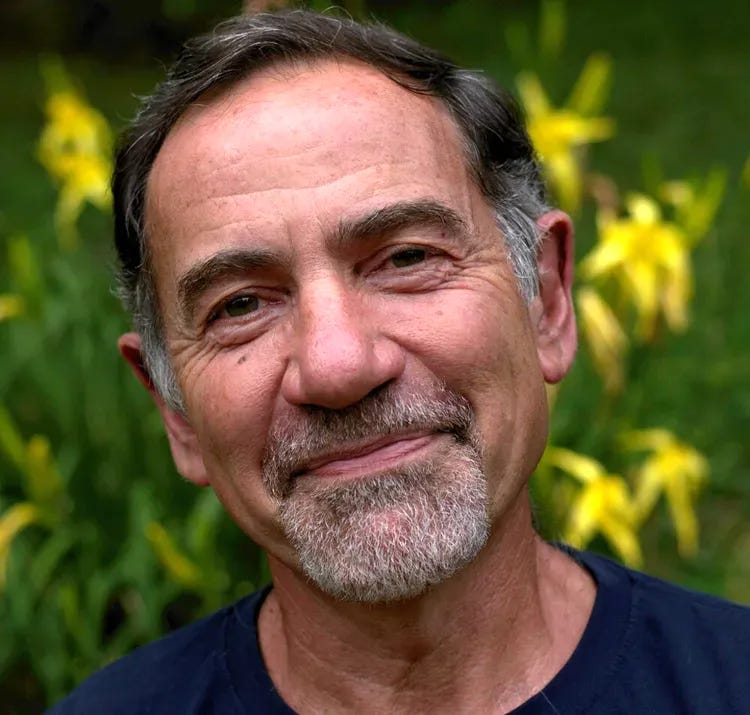
Anthony Flaccavento is the Executive Director of the Rural Urban Bridge Initiative, the parent organization of Community Works. He lives, farms and works in southwest Virginia.