
As the World Cup and the atmosphere around it has ended, it’s worth savoring the reminders it gave us.
By Iliana Santillán
Beacon Media
I went to Mexico this summer as someone who had never cared much about soccer. Much to my surprise, within days I was planning my life around World Cup games, wearing a green jersey and singing with strangers after Mexico won.
Something had changed, and it was not only my opinion of the sport.
As soon as I landed in Mexico, the feeling of otherness left my body. I had not realized how much I carried it until it disappeared. Spanish surrounded me. Giant images of the Mexican national team covered buildings. Brands had transformed their advertisements into messages of encouragement for la Selección, Mexico’s national team. Green jerseys filled airports, subway stations, restaurants and city streets.
Everywhere I looked, the World Cup was there. Mexico felt radiant, and for the first time in a long time, I experienced that pride without feeling the need to explain or defend it.
Growing up in Mexico (before moving to the U.S. at age 12 and spending the last 23 years in North Carolina), soccer was impossible to ignore, but I never felt like it belonged to me. Like many women who grew up in the 1980s and ‘90s, I associated the sport with a familiar image: men glued to the television, the final score determining the mood of the afternoon, while commercials and popular culture often showed women serving food or observing from the sidelines.
This World Cup felt different. Somewhere along the way, I became what we jokingly call a FIFA in Mexico—a woman who suddenly discovers her inner soccer fan, especially during the World Cup. I bought the jersey, learned the players’ names, celebrated every goal and, during the weeks I spent with my dad, even planned our days around the games.
I had officially entered my FIFA era.
The World Cup brought me closer to my dad, reconnected me with parts of my heritage I had not realized I missed, and reminded me how powerful it can be to celebrate where we come from without making anyone else feel that they do not belong.
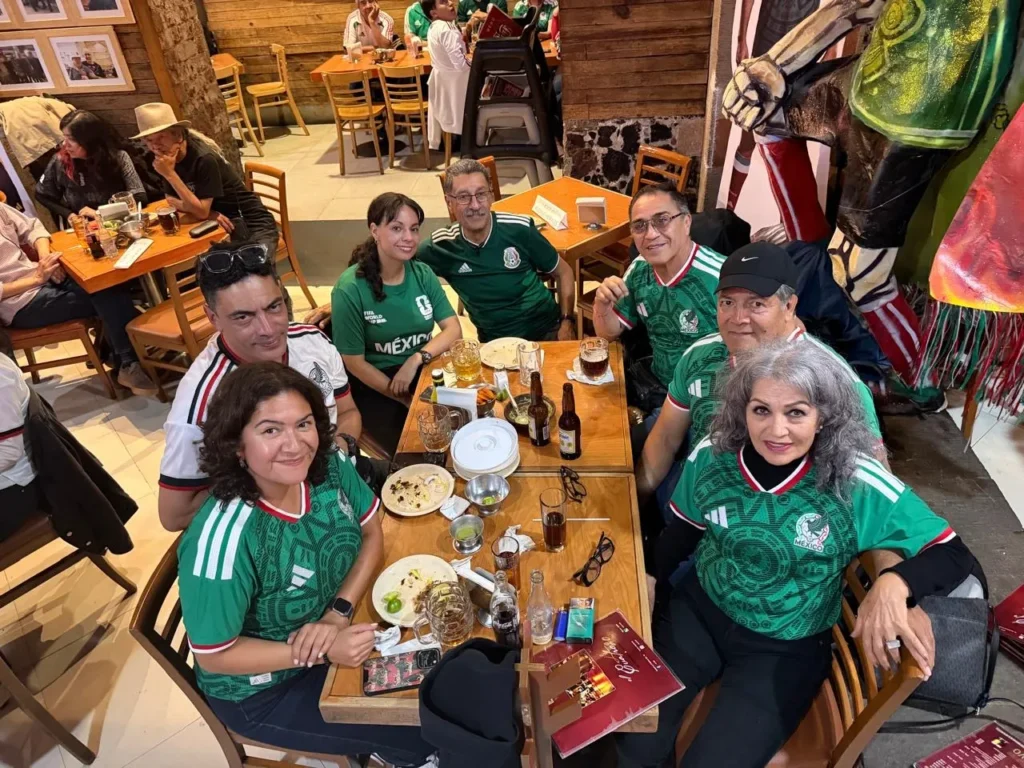
Every important game brought my dad and me back to his favorite neighborhood restaurant in Mexico City, not far from the central Zócalo, where one of the country’s largest fan festivals took place. We ate tacos al pastor, spent hours with his friends and were greeted by familiar faces each time we returned. A photograph of my dad and his friends with the owner hangs on the wall, a small detail that helps explain why the place feels like home.
College friends met up to watch. Couples turned games into dates. Retirees debated every play, fathers watched alongside their daughters, and a few children absorbed the excitement around them. People came for soccer but stayed for hours, talking and laughing long after the games ended.
That is one of the things I love most about Mexico: the ability to linger, to sit around a table without watching the clock and to make room for sobremesa, another story or one more person pulling up a chair.
When Mexico won, that feeling spilled into the streets. The restaurant erupted. People hugged strangers, and without anyone planning it, everyone began singing Cielito Lindo. Outside, cars stopped as people climbed out to dance. Bands played music in the streets.
Thousands celebrated at the Ángel de la Independencia, and even the rain could not send them home.
Mexico erupted in joy, pride and hope.
For weeks, the world saw a version of Mexico that rarely leads the news. Visitors experienced extraordinary hospitality, remarkable food and public spaces filled with celebration. They walked our streets, celebrated alongside us and experienced a country that welcomed them with pride and generosity.
None of that erases the challenges Mexico faces. But those challenges have never been the whole story. Sometimes we spend so much time responding to other people’s narratives that we forget to tell our own.
Making it to the World Cup is an extraordinary achievement. Every team arrives carrying its country’s history and the stories of players whose journeys cannot be reduced to a score or statistic. Once I started learning those stories, I was hooked.
One afternoon, while watching a game in Oaxaca, the province to the South of Mexico City, an American walked into the bar wearing a Team USA jersey.
He was welcomed immediately, and before long much of the bar was cheering for the United States alongside him. That moment captured one of the most important things the World Cup taught me: pride in your own country does not have to come at the expense of someone else’s.
I came home with a Mexico jersey in my suitcase and a deeper connection to my dad, my heritage and a part of myself I had not realized I missed.
I hope the next generation grows up proud of where they come from and curious about everyone else. I hope young people experience the joy of seeing their countries compete, their stories represented and new possibilities open before them. I hope they learn that celebrating their own history never requires diminishing someone else’s.
Iliana Santillán is an immigrant from Mexico, founder of the movement group Brava NC, and a statewide leader advancing civic engagement and political power-building in North Carolina. She is the co-host of Beacon Media’s Latino community media project, El Faro. This column is syndicated by Beacon Media and is available to republish for free on all platforms under Beacon Media’s guidelines.