
Growing up as the daughter of undocumented immigrants, the author knew fear and uncertainty. Now, amid a federal crackdown aimed at Latino immigrants, she felt that again — until she saw her community respond.
By Andressia Ramirez
Beacon Media
Editor’s Note: Download Andressia’s headshot here.
“What’s giving you hope?”
It’s a question I had come to dread. It comes up constantly in advocacy spaces these days, including all around North Carolina. I always find an answer, but the truth is, I hadn’t really felt hopeful in a long time — until recently.
The last year has been emotionally shattering. Undocumented people have always lived with fear, rooted in lacking a piece of paper that dictates whether your life is considered valid or disposable. Now, federal agents are stopping people for how they look, not what they’ve done. We’re seeing U.S. citizens killed by federal immigration agents. People are starting to understand that no one is safe. Entire communities are canceling medical appointments. Parents are not taking their children to school. People are skipping work, not because they want to, but because survival requires caution. Fear has become a daily calculation.
I know this feeling intimately. And not just from this year.
My parents immigrated from Querétaro, Mexico, and settled in Wilson County, N.C, when I was 8 years old. I remember learning in elementary school that my mother was undocumented. From that moment on, it became our biggest secret. I couldn’t tell anyone because anyone knowing could be a threat. My brothers and I grew up understanding that our mother could be taken from us with no warning.
We learned how to listen carefully, how to stay quiet, how to carry fear without letting it show.
For most of my life, I held onto one hope: that one day my mom would become a citizen. In high school, I felt an overwhelming need be the absolute best student, so that one day I could petition for her. She obtained her green card the year I graduated from college in 2019 and became a citizen in 2025.
I thought that my mother’s naturalization would feel like a triumph. That I would finally feel like I could breathe; that we were safe. That I would no longer live in fear. But in the wake of the 2024 election, I realized that even citizenship does not erase the trauma, exhaustion, and vigilance that immigrant families like mine carry. Right now, fear persists for one painfully clear reason: it does not matter if you are a U.S. citizen. Recent federal immigration enforcement has shown, repeatedly, that citizenship does not protect you.
What I’ve learned in recent months is that hope is not found in a document or a legal status. Hope lives in people. It lives in neighbors stepping up to learn their rights, volunteers joining rapid response networks, and local leaders pushing back on policies that make our communities less safe.
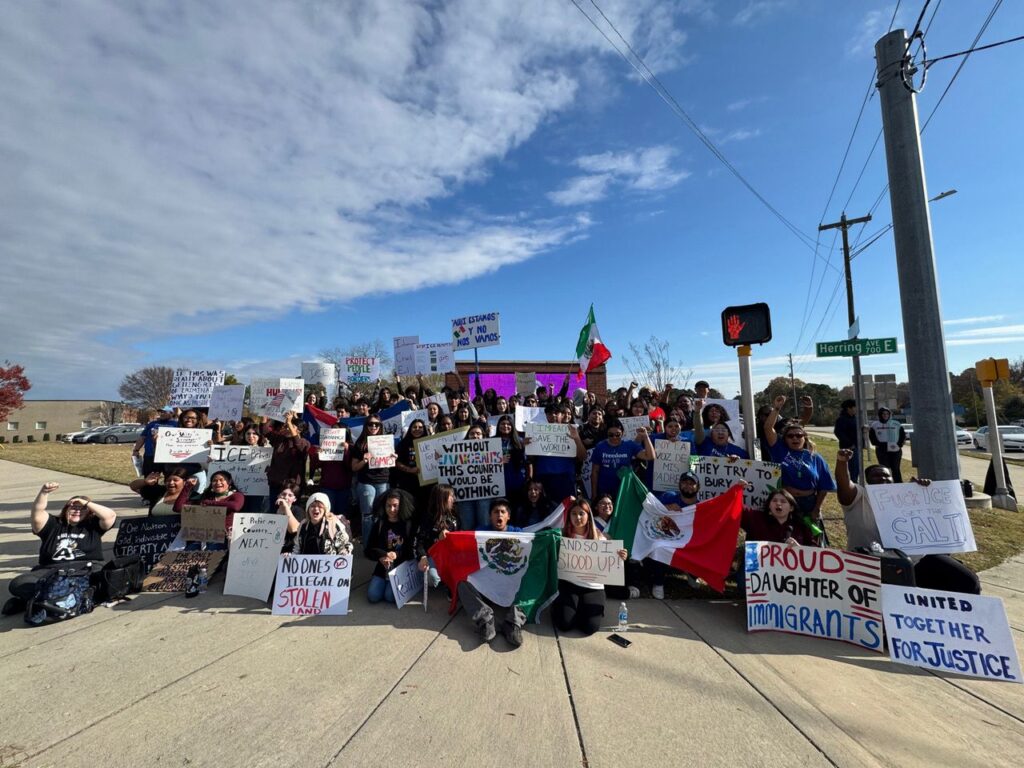
For me, it was found at home in November while supporting the first-ever youth-led protest in Wilson. It was in the middle of a surge of federal officers during what they called Operation Charlotte’s Web, and rumors were flying that U.S. Immigration and Customs Enforcement (ICE) was spreading into eastern North Carolina. Students from the local high schools responded by organizing a walk-out and rally. They did everything, from working with teachers to ensure the rally wouldn’t jeopardize their future prospects, to painting signs and securing a speaker.
Everyone was afraid, but we were pushing each other to be brave
It wasn’t just Latino kids, either. There were black kids, white kids, kids of all backgrounds and ages who stood together.
The crowd was chanting when someone, unexpectedly, handed the megaphone over to me. I hadn’t planned on leading chants. I felt my voice would break. That I would try to yell and nothing would come out. Despite my relative safety and experience, I felt uncertain.
I yelled into the megaphone: “If ICE comes to Wilson, what do we do?
“Stand Up! Fight Back!” they shouted.
I felt a surge of pride. And a new answer to the question about something giving me hope. I want these students to recognize the power they hold – and the power they’re giving to us.
I hate that teenagers are compelled to protest. I grieve that they’re carrying the same fear that paralyzed me.
I fear that if we don’t do something about this now, they’ll still be feeling that fear in 10 years.
When I was their age, I held my first protest sign begging this country to see my undocumented mother as a human being. I begged for safety. For acceptance. For the right to exist in the only home I had ever known. I never imagined I would see young people, almost a decade later, fighting a different version of the same battle.
And yet, I am hopeful. And while I hate that they have to take on this fight, I am grateful for the young people of my community for standing up for all of us.
I’m watching the next generation rise with clarity, courage and conviction. They remind me of the fire I once carried before too many defeats dimmed it.
In Spanish, we say vivir en las sombras, or “to live in the shadows.” But the next generation refuses, choosing each other over silence, community over isolation. And as long as we keep building power, across communities, across languages, across counties, the shadows will never be able to swallow us again.
Andressia Ramirez is an advocate at the North Carolina Justice Center, raised in Wilson, North Carolina by parents from Querétaro, Mexico. This column is syndicated by Beacon Media and is available to republish for free on all platforms under Beacon Media’s guidelines.
Opinión: Hija de inmigrantes encuentra esperanza en la comunidad
Al crecer como hija de inmigrantes indocumentados, la autora conoció el miedo y la incertidumbre. Ahora, en medio de una campaña federal dirigida en contra de los inmigrantes latinos, volvió a sentirlo – hasta que vio la respuesta de su comunidad.
Por Andressia Ramirez
Beacon Media
“¿Qué te da esperanza?”
Es una pregunta que había llegado a temer. Estos días surge constantemente en espacios de abogacía, en todas partes de Carolina del Norte. Siempre encuentro una respuesta, pero la verdad es que no me había sentido realmente esperanzada en mucho tiempo, hasta hace poco.
El último año ha sido emocionalmente devastador. Las personas indocumentadas siempre han vivido con miedo, arraigado en la falta de un simple documento que determina si la vida de alguien es útil o desechable. Actualmente, agentes federales detienen a las personas por su imagen, por como se ven, no por lo que han hecho. Estamos viendo cómo ciudadanos estadounidenses son asesinados por agentes federales de inmigración. La gente está empezando a comprender que nadie está seguro. Comunidades enteras están cancelando sus citas médicas. Padres y madres no están llevando a sus hijos a la escuela. La gente está faltando al trabajo, no porque quiera, sino porque la supervivencia requiere precaución. El miedo se ha convertido en un cálculo diario.
Conozco esta sensación íntimamente. Y no solo desde este año.
Mis papás emigraron de Querétaro, México, y se establecieron en el condado de Wilson, Carolina del Norte, cuando yo tenía 8 años. Recuerdo que en la primaria me enteré de que mi mamá era indocumentada. A partir de ese momento, se convirtió en nuestro mayor secreto. No podía contárselo a nadie porque el que alguien lo supiera podría ser una amenaza. Mis hermanos y yo crecimos entendiendo que nos podían quitar a nuestra mamá sin previo aviso.
Aprendimos a escuchar atentamente, a guardar silencio, a cargar con el miedo sin dejar que se notara.
Durante la mayor parte de mi vida, mantuve una esperanza: que algún día mi mamá se convirtiera en ciudadana. En la preparatoria, sentía una necesidad abrumadora de ser la mejor estudiante, para que algún día pudiera solicitar la ciudadanía para ella. Mi mamá obtuvo su tarjeta de residencia el año en que me gradué de la universidad en 2019, y se convirtió en ciudadana en 2025.
Pensé que la ciudadanía de mi mamá se sentiría como un triunfo. Que finalmente podría respirar libremente, que estábamos a salvo, que ya no viviría con miedo. Pero a raíz de las elecciones del 2024, me di cuenta de que ni siquiera la ciudadanía borra el trauma, el agotamiento y la paranoia que cargan las familias inmigrantes como la mía. En este momento, el miedo persiste por una razón dolorosamente clara: no importa si eres ciudadano estadounidense. Las recientes medidas federales de control de inmigración han demostrado, una y otra vez, que la ciudadanía no te protege.
Lo que he aprendido en los últimos meses es que la esperanza no se encuentra en un documento o en un estatus legal. La esperanza vive en las personas. Vive en los vecinos que se organizan para conocer sus derechos, en los voluntarios que se unen a redes de respuesta rápida y en los líderes locales que se oponen a las políticas que hacen que nuestras comunidades sean menos seguras.
En mi caso, la encontré en casa en noviembre mientras apoyaba lo que fue la primera protesta liderada por jóvenes en Wilson. Estábamos en plena oleada de agentes federales durante lo que ellos llamaron Operación Charlotte’s Web y había rumores de que el Servicio de Inmigración y Control de Aduanas de Estados Unidos (ICE) se estaba expandiendo a el este de Carolina del Norte. Los estudiantes de las escuelas preparatorias locales respondieron organizando una manifestación. Hicieron todo, desde trabajar con sus maestros para garantizar que la manifestación no pusiera en riesgo sus prospectos a futuro, hasta pintar pancartas y conseguir un orador.
Todos tenían miedo, pero nos animábamos los unos a los otros para ser valientes.
Y no solo eran estudiantes latinos. Había jovenes negros, blancos, gente de diversos orígenes y edades que se unieron.
La multitud estaba entonando consignas cuando de repente, alguien me pasó el megáfono. No tenía pensado dirigir los lemas de protesta. Sentí un nudo en la garganta . Llegué a pensar que intentaría gritar y no me saldría nada. A pesar de mi relativa seguridad y experiencia, me sentía insegura.
Grité por el megáfono: “¿Si ICE viene a Wilson, qué hacemos!?”
“¡Levantarnos y Luchar!”, gritaron.
Sentí una oleada de orgullo. Y una nueva respuesta a la pregunta sobre qué me daba esperanza. Quiero que estos estudiantes reconozcan el poder que tienen, y el poder que nos están dando a nosotros.
Odio que los adolescentes se vean obligados a protestar. Lamento profundamente que lleven consigo el mismo miedo que a mí me paralizó.
Me preocupa que si no hacemos algo al respecto ahora, seguirán sintiendo ese miedo en 10 años.
Cuando tenía su edad, sostuve mi primera pancarta de protesta suplicándole a este país que viera a mi madre indocumentada como un ser humano. Rogué por seguridad. Por aceptación. Por el derecho a existir en el único hogar que he conocido. Nunca imaginé que vería a jóvenes, casi una década después, luchando una versión diferente de la misma batalla.
Y sin embargo tengo esperanza. Y aunque detesto que tengan que asumir esta lucha, estoy agradecida con los jóvenes de mi comunidad por defendernos a todos.
Estoy viendo cómo la próxima generación crece con claridad, valentía y convicción. Me recuerdan al fuego que una vez llevé dentro antes de que demasiadas derrotas lo apagaran.
Entre nosotros decimos “vivir en las sombras”. Pero la próxima generación se niega a hacerlo y se eligen los unos a los otros en lugar del silencio, la comunidad en lugar del aislamiento. Y mientras sigamos construyendo poder a través de las comunidades, a través de los idiomas y a través de los condados las sombras nunca podrán atraparnos otra vez.
Andressia Ramírez trabaja en el Centro de Justicia de Carolina del Norte. Fue criada en Wilson, Carolina del Norte, por padres originarios de Querétaro, México. Esta columna es distribuida por Beacon Media y está disponible para su reproducción gratuita en todas las plataformas bajo las directrices de Beacon Media.